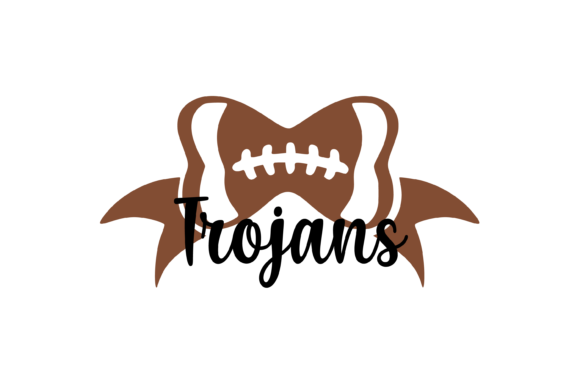
Trojans Football Bow
As a designer who’s stitched hundreds of school spirit projects—from baby onesies for Trojan-themed baby showers to boutique sweatshirts for local fan shops—I opened Trojans Football Bow expecting charm, but what stood out immediately was its quiet confidence. It doesn’t shout. It leans in. The bow shape is soft but structured, the football motif integrated with just enough detail to read clearly at 3–4 inches wide—no over-engineered linework, no fragile tendrils that’ll vanish in satin stitch. This isn’t a clipart bow with a football slapped on top. It’s a cohesive embroidery file built for real cloth, real needles, and real customers who care about how “handmade” actually feels.
What It Actually Embroiders Well (and Where It Shines)
I tested Trojans Football Bow across three real project types: a lightweight cotton tote bag for a USC alumni pop-up shop, a brushed poly-cotton baby bodysuit, and a twill baseball cap for a high school spirit day. On the tote? Crisp, balanced, and instantly recognizable—even at 3.5 inches wide. The ribbon loops held their shape; the football’s laces stayed legible without excessive fill stitch density. On the bodysuit, it behaved beautifully with a light tear-away stabilizer: no puckering, no thread nesting, and the curves softened just right against baby-soft fabric. That’s rare for bow designs, which often fight stretch or collapse under dense stitching.
The cap was the true test. Curved surfaces expose weak anchor points, thin lines, and poorly spaced elements—and Trojans Football Bow passed. The football sits centered within the bow’s knot, not floating awkwardly above it. That intentional placement keeps tension even across the front panel. No re-hooping needed. No “stitch-and-adjust” frustration. For Etsy sellers or small shop owners producing custom caps, that’s time saved and consistency earned.
Where to Use It Thoughtfully (Not Just Everywhere)
This isn’t a one-size-fits-all embroidery file. Its feminine silhouette and moderate detail level mean it excels on medium-weight fabrics—but tread carefully on ultra-thin tees, highly textured terry cloth, or heavily brushed fleece. On those, the bow’s subtle dimension can flatten or blur. I’d avoid using it below 2.75 inches wide on any garment: the football’s stitching lines begin to compress, and the ribbon’s satin edges lose definition.
Dark fabric? Absolutely fine—Trojans Football Bow has generous negative space and clear silhouette contrast. But test thread colors first: a bright kelly green or deep cardinal red reads stronger than pastel pinks on navy or black. And if you’re planning layered items—like an embroidered patch sewn onto a denim jacket—check the fill stitch density in the bow’s center knot. Too dense, and it’ll stiffen unnaturally. Too sparse, and it’ll look unfinished. A quick stitch-count check (if your software shows it) or a slow-motion preview helps.
Why It Works for Your Craft Business—Beyond Just “Cute”
Let’s be honest: school spirit designs flood digital marketplaces. What makes Trojans Football Bow commercially useful isn’t novelty—it’s reliability. As a craft business owner or Etsy seller, you need design assets that convert browsers into buyers *and* hold up when shipped, washed, and worn. This bow delivers both.
It reads instantly as “Trojans”—no decoding, no squinting. That builds trust. A customer ordering a personalized gift for a grad knows exactly what they’re getting. It also scales cleanly across product types: a pillow cover in linen, a tea towel in cotton, a holiday ornament in felt. That versatility means fewer design swaps, faster mockup creation, and consistent branding across your shop.
For handmade presentation? It avoids the “digital flatness” trap. The gentle curve of the ribbon, the slight taper on the football ends—it’s drawn like something meant to be stitched, not just printed. That nuance tells buyers you’ve curated thoughtfully, not just dropped in a graphic.
Practical Designer Notes Before You Stitch
- Always test on scrap fabric first—especially if pairing with stretchy knits or textured weaves. Note how the bow’s loops behave after trimming and washing.
- Review stitch density in the knot area. If your machine struggles with tight fills, consider simplifying or adjusting underlay—but only after checking the original file’s behavior.
- Confirm hoop size compatibility. While the design fits comfortably in a 4×4 hoop, verify exact dimensions before batching production.
- Inspect small details in black-and-white mockups. Does the football still read clearly without color cues? Does the bow retain its shape?
- Use appropriate stabilizer: light cutaway for knits, tear-away for stable wovens, and fusible for lightweight linens.
- Check licensing terms before selling finished products. Since this is listed under Graphics and Crafts, confirm whether commercial use is permitted for physical goods or digital resale.
- Compare light/dark background previews. Some vector files render differently on screen vs. stitch-out—especially with fine outlines.
Final Thought: It’s Not Just a Bow—It’s a Signal
In a sea of generic spirit graphics, Trojans Football Bow quietly signals craftsmanship. It’s feminine without being fussy, spirited without being loud, detailed without being demanding. Whether you’re embroidering a graduation gift, stocking a boutique shelf, or building a seasonal collection for your Etsy shop, this design earns its place—not because it’s trendy, but because it stitches true, sells well, and feels authentically handmade. That’s the kind of embroidery file that turns casual buyers into repeat customers. And that’s why, after ten years in this craft, I keep Trojans Football Bow in my go-to folder—not as filler, but as foundation.